

We get it. SARMs are complicated. You look at all the name codes, graphs and charts, and don’t really see which is the one that’s supposed to help you get more muscle mass or lose weight.
This entry barrier is the trade-off for SARMs’ effectiveness: these compounds are a little more complicated than — for example `— anabolic steroids, and that’s PRECISELY why they work better and do their job in a safer, more targeted way.
We can confidently claim three things now:
- SARMs are MUCH easier than they seem to be;
- Understanding them is more than worth it;
- And you can understand it in 10 minutes or less.
Here’s the guide that will give you more than enough information to feel comfortable with this class of performance enhancement compounds. We’ll start from the very basics and move on to practice towards the end.
- What are SARMs?
- What SARMs actually do, in plain terms?
- Why are there so many SARMs?
- SARMs Stacks: Mixing Signals, Not Just Turning the Volume Up
- Why stacking SARMs exists as a practice at all
- Why stacks are considered advanced territory
- Is stacking SARMs inherently unsafe?
- When SARMs stacks actually make sense
- How to choose the best SARM for you?
- Step 1 — How to pick SARMs for beginners or PROs?
- Step 2 — How to choose SARMs for your goals?
- Step 3 — How to Choose Between a “Stronger” and a “Weaker” SARM?
- Conclusion
- References
What are SARMs?
First of all, the definition.
SARMs stands for Selective Androgen Receptor Modulators.
That sounds complicated, but the idea is simple:
- Your body has tiny “switches” called androgen receptors;
- These switches tell certain tissues what to do;
- These switches “activate” when something connects to them.
When those switches are turned “on”, they make the tissue do something:
- Muscles — get stronger and grow;
- Bones — get denser and more resilient;
- Skin — starts producing oil;
- Scalp — tightens up.
All tissues do something as a reaction to the activation of these receptors.
How does the body normally turn those receptors on?
Naturally, it uses testosterone to activate them. Testosterone is the original androgen receptor modulator (or activator), and anabolic steroids (artificial modifications of it) are the most popular injectable versions of it.
The problem is, testosterone and steroids don’t know where to go. They just go everywhere they can. All around your body.
It turns on switches in:
- Muscles (the desired effect);
- Bones (a positive side effect);
- Skin (and it’s bad — that’s why steroidal acne exists);
- Scalp (bad as well, too much testosterone means losing hair);
- Prostate (bad, it enlarges and causes problems);
- Heart (bad too, it enlarges as well and causes problems with blood pressure).
That’s why steroids work so well on muscle growth: it’s natural. And that’s also why they cause so many side effects: your body is not expecting them to come as injections or pills.
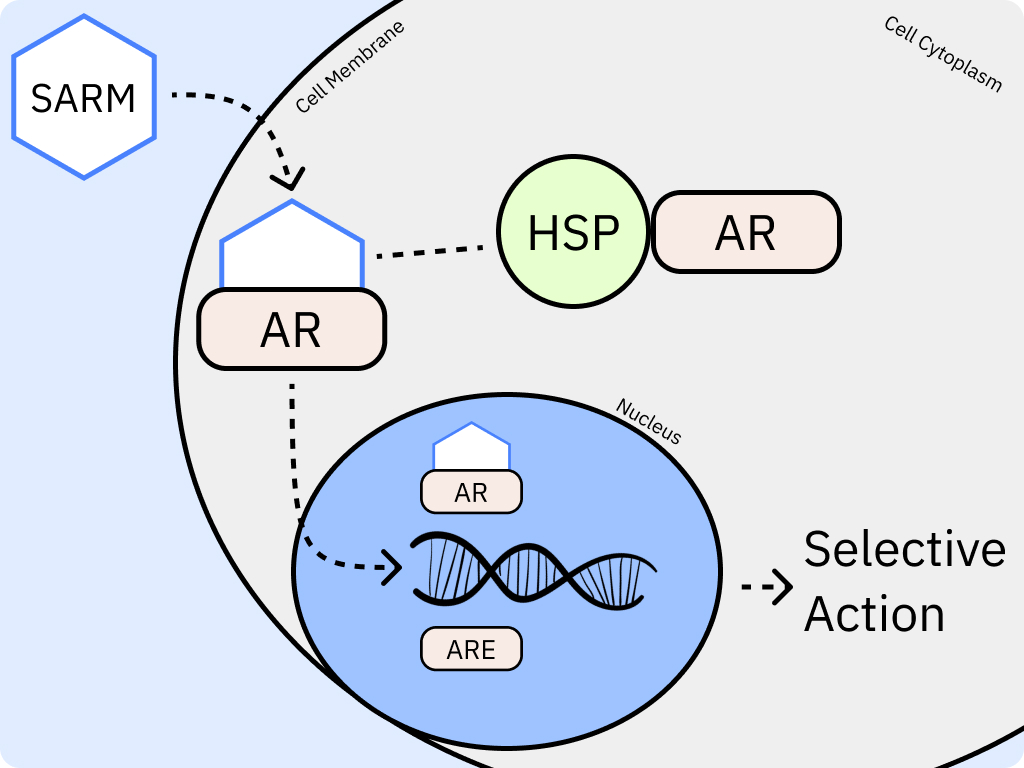
How are SARMs different from steroids?
SARMs were designed to be selective. Hence the name, selective androgen receptor modulators.
SARMs are built to:
- Strongly activate androgen receptors in muscle and bone;
- Barely affect these receptors in other tissues, like the prostate or heart.
That’s the entire point of SARMs: to provide the benefits of anabolic steroids (muscle growth, better bone density, more endurance) without the steroidal side effects (acne, suppression, and heart damage).
SARMs are developed by pharmaceutical companies worldwide (like Ligand Pharmaceuticals — the one behind Ligandrol) not for bodybuilders, but for people with muscle wasting diseases.
However, as it usually happens, the fitness crowd is not waiting for a new technology to get approved. That’s why, since the early 2000’s, SARMs have been getting more and more popular in locker rooms worldwide.
What SARMs actually do, in plain terms?
There’s a limited set of effects, regardless of which SARM you choose. They all:
- Tell muscles to hold onto tissue (to keep it and preserve what’s there);
- Tell same muscles to build more tissue from protein (and grow);
- Preserve strength during dieting (because calorie deficit “burns” muscles first);
- Improve body composition (because you lose fat — but grow and retain muscles).
SARMs do not:
- Instantly build muscle without training (you still need workouts);
- Replace proper nutrition (without “materials”, aka protein, muscles don’t grow);
- Work like steroids dose-for-dose (SARMs are not as crazy-fast as Trenbolone).
They amplify what you’re already doing — selectively. And that’s the whole point.
Why are there so many SARMs?
Remember the androgen receptor — the “switch”?
That switch behaves slightly differently in different tissues and situations. So researchers started asking questions:
- What if we activate the receptor gently, just barely attach a SARM molecule to it?
- And what if we activate it really hard instead, attach hard and deep?
- What if we make the activation last longer? Or shorter?
- Can we bias SARMs toward receptors in muscles — and less towards bone tissue?
- What if we reduce activity in (for example) the prostate even more, will it still work in muscles?
- Etc.
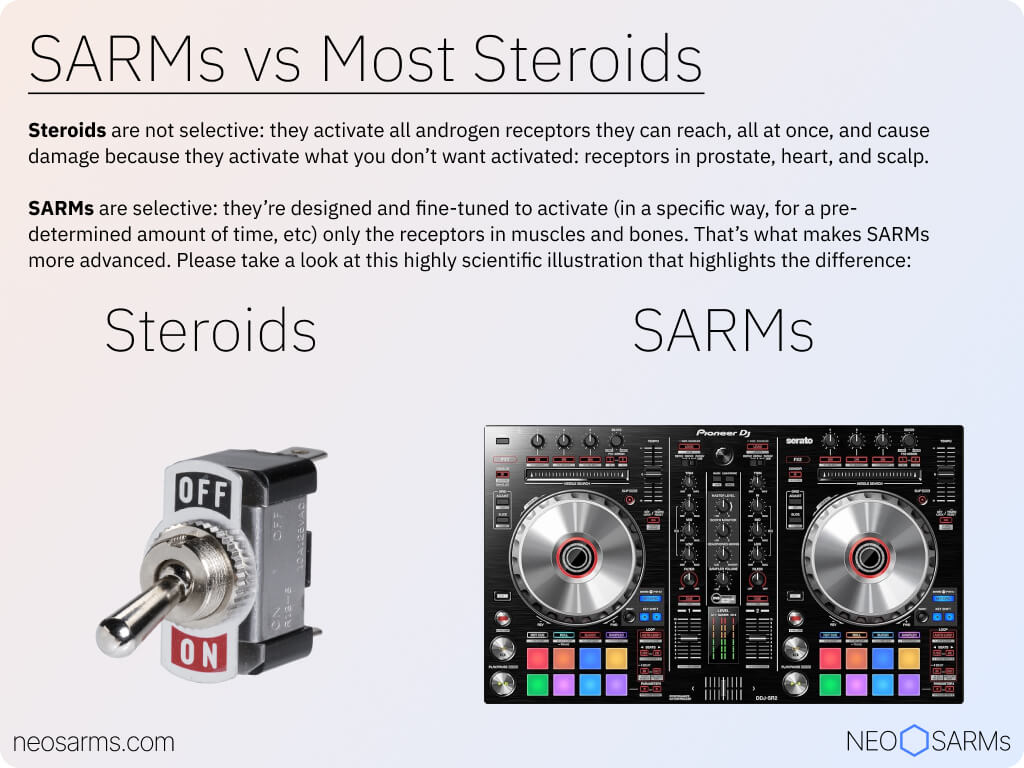
Each new SARM is basically a different take on the same idea. Think of SARMs as fine-tuning — not on/off switches.
In fact, it’s steroids (mostly the development of 1950s) that are an on/off switch:
- Everything turns on;
- Everywhere;
- All at once.
Inject — grow — deal with consequences later.
SARMs, which still get research “updates” in mid-2020’s, are precise volume knobs:
- Some turn the muscle signal up a little;
- Some turn it up more;
- Some focus on strength (muscle’s function, not physical volume growth);
- Some focus on preservation (barely growing but holding to what;s there stronger).
That’s why there isn’t “the best SARM”. There’s only the right SARM for a specific goal and experience level. And that’s exactly why they get these “weird” names like GW-501516 or YK-11: these are research codes, not “market-friendly” names.
SARMs Stacks: Mixing Signals, Not Just Turning the Volume Up
Earlier, we compared SARMs to volume knobs instead of on/off switches.
That analogy goes one step further.
If a single SARM is one volume knob, then stacking SARMs is like mixing tracks as a DJ.
You’re not just making the music louder — you’re changing the texture, the balance, and the feel of the result.
Why stacking SARMs exists as a practice at all
No single SARM does everything perfectly. One might be great at preserving muscle but weak at strength improving or endurance. Another might boost strength but not recovery.
But what if you want BOTH endurance and strength?
Stacking exists precisely because different SARMs emphasize different signals inside the body. When combined thoughtfully, they can complement each other in ways a single compound can’t.
What stacking SARMs actually changes?
Stacking SARMs doesn’t magically create new effects, it changes how strongly and where signals overlap.
Instead of one moderate signal in one direction, you get multiple aligned signals working together.
This can mean:
- Better recomposition than a single compound;
- Strength without unnecessary size;
- Endurance without muscle loss;
- Or a more “complete” outcome for advanced goals
Think of it as layering, not escalation.
Why stacks are considered advanced territory
Stacking increases complexity, not just results. With one SARM:
- It’s easier to understand what’s happening;
- Easier to assess how your body responds;
- And again, easier to recover from it.
With multiple SARMs:
- Effects overlap;
- Suppression risk can increase;
- Recovery planning matters more;
- Mistakes are harder to diagnose
That’s why stacking isn’t recommended for complete beginners: you need a reference point first.
Is stacking SARMs inherently unsafe?
No — stacking itself is not the problem. The problem is stacking without understanding.
When users know:
- What each compound contributes;
- How they interact conceptually;
- And what the tradeoffs are;
Stacks can be used responsibly.
But stacking blindly — chasing “more” instead of “better” — is where people run into trouble.
When SARMs stacks actually make sense
Stacks are typically explored when:
- Single-compound experience is already established
- Goals become more specific;
- Or when you want outcomes a single SARM can’t deliver alone.
It’s all in precision and synergy.
How to choose the best SARM for you?
To choose the best SARM for your goals, you should determine three simple things:
- How new are you to SARMs and PEDs (performance enhancement drugs) in general?
- What exactly do you want to achieve? What’s your goal?
- How much of a “help” do you want your SARMs to be?
The simplest way to go is to use DEDUCTION: from the overall mass of SARMs (we currently have 11 in our store), subtract the one you need.
In other words, rule out the ones you CAN take, then — of what’s left — pick the ones that you WANT to take (by your goal), and — if there’s several left to choose from — pick the one that’s stronger or milder, and go with it.
Step 1 — How to pick SARMs for beginners or PROs?
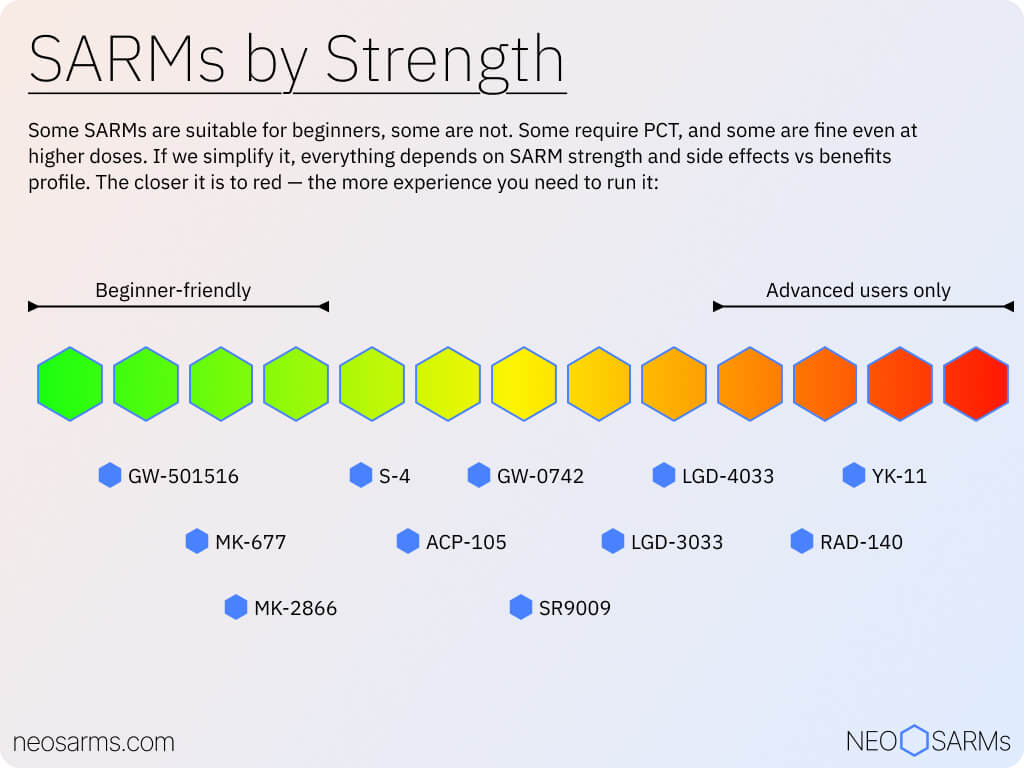
Not all SARMs are equal — and the difference isn’t just “how strong they are.” The real difference is how much responsibility they require from the user. As SARMs become more powerful, they stop being “set and forget” compounds and start demanding:
- Planning;
- Monitoring;
- Recovery strategy;
- And sometimes additional support compounds.
That’s why experience matters.
What changes as SARMs get stronger?
Just 4 key points actually change:
Hormonal suppression becomes more likely
Milder SARMs may cause little to no suppression (lowering the production of natural testosterone). Stronger SARMs are much more likely to reduce it notably.
At a certain point, you can’t ignore recovery anymore.
That’s where post-cycle planning, hormone support and recovery timelines start to matter.
2. Post-Cycle Therapy (PCT) becomes relevant
Beginner-level compounds are often chosen specifically because they are easier to recover from and don’t always require aggressive intervention afterwards.
Stronger SARMs, on the other hand, may require:
- Structured PCT (with, for example, Nolvadex);
- Proper timing;
- Understanding of how recovery actually works.
This is not optional knowledge — it’s part of using advanced compounds responsibly.
3. On-cycle monitoring matters more
As intensity increases, so does the need to pay attention. That can include:
- How you feel day to day
- Changes in energy, sleep, or mood;
- How your body responds under training stress.
Advanced users don’t just “run a cycle” — they observe and adjust on-the-go. It’s a skill that comes with experience, so no beginner has it “by default”.
4. Ancillary support may be required
Some SARMs are simple by design. Others may require:
- Additional compounds for balance (Nolvadex, Arimidex, Telmisartan, for example);
- Extra attention to recovery and stress;
- More conservative training or diet adjustments.
This is why advanced SARMs are not recommended for first-time users. You don;t want to overload your body with 4 different pills simultaneously if you take all 4 for the first time.
How to use the SARMs Strength chart above (important)
The chart isn’t ranking SARMs by “how good they are.”
It ranks them by intensity, complexity, and experience required to use them responsibly.
“Green” options are:
- Simpler;
- Easier to recover from;
- Better for learning how your body responds.
SARMs “in red” have:
- Stronger effects;
- Higher suppression risk;
- A need for more planning and awareness.
Here’s the full scale:
There is no prize for starting higher on the scale. So choose your starting pool of SARMs wisely.
Step 2 — How to choose SARMs for your goals?
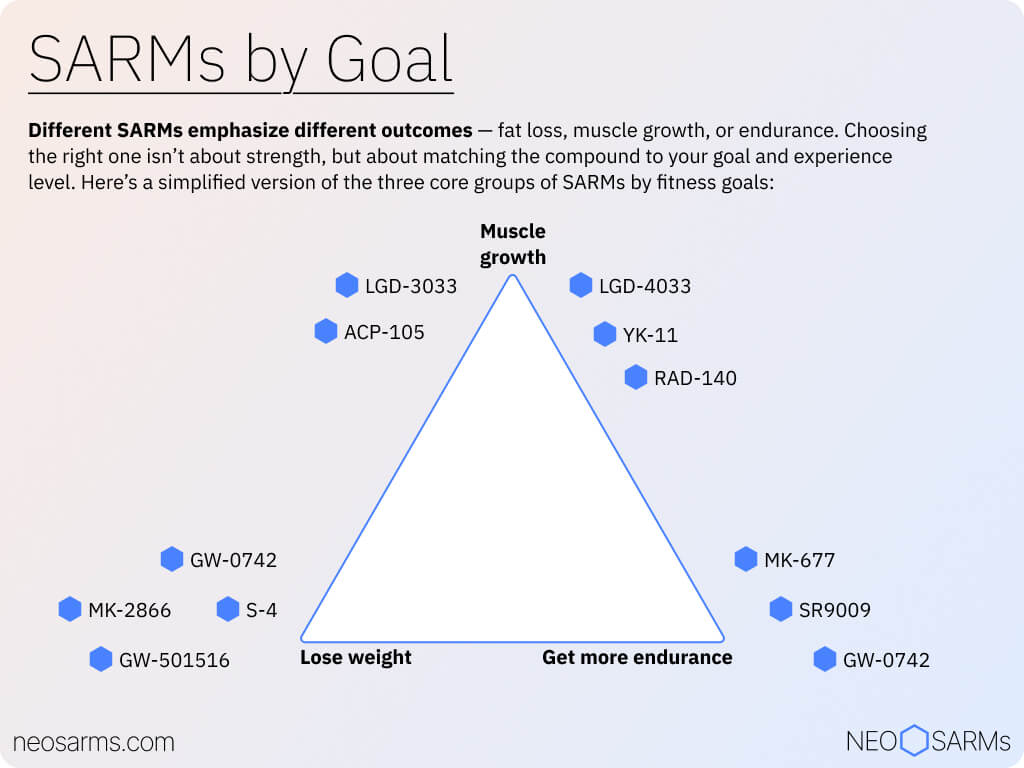
At this point, it’s fair to bring some good news: we already know how different SARMs behave in the body.
There’s no need to guess or experiment. Over the years, SARMs have been studied, tested, compared, and used in very specific fitness contexts. So we (meaning “we” as the NEO SARMs team, “we” as the fitness community, and “we” as modern science in general) understand:
- How each SARM attaches to androgen receptors;
- How strongly it activates them;
- How long it stays active;
- And how much overall stress it places on the system.
Based on that, we can reliably group SARMs by what they are actually good at.
That’s why it’s possible to say things like:
- “This SARM works better for cutting”;
- “This one makes more sense for lean bulking”;
- “This one is strength-focused”;
- And so on.
Simplifying fitness goals to the core
Despite how complicated the fitness world tries to make things — programs, splits, protocols, stacks, phases — most people are chasing one of just a few outcomes.
When you strip away the noise, almost everyone fits into one of these goals:
- Lose fat (and not look flat or weak);
- Get bigger and stronger (add noticeable muscle mass and strength);
- Improve endurance without increasing size (in running or in martial arts).
That’s it.
Different sports, different aesthetics, different training styles — but the underlying goals are remarkably consistent. Just 3 goals. And that’s exactly how the next section is structured.
PLEASE NOTE: We at NEO SARMs understand that for more experienced athletes, more aspects matter. Strength & muscle density — not volume, or endurance — with no need for recovery (for example, if peptides like BPC-157 are utilized for recovery goals). That’s why on all products you’ll see a 6-point radar chart with effects, not the simplified 3-way one. It’s still perfectly usable & reliable for beginners as well.
SARMs for Weight Loss & Recomposition
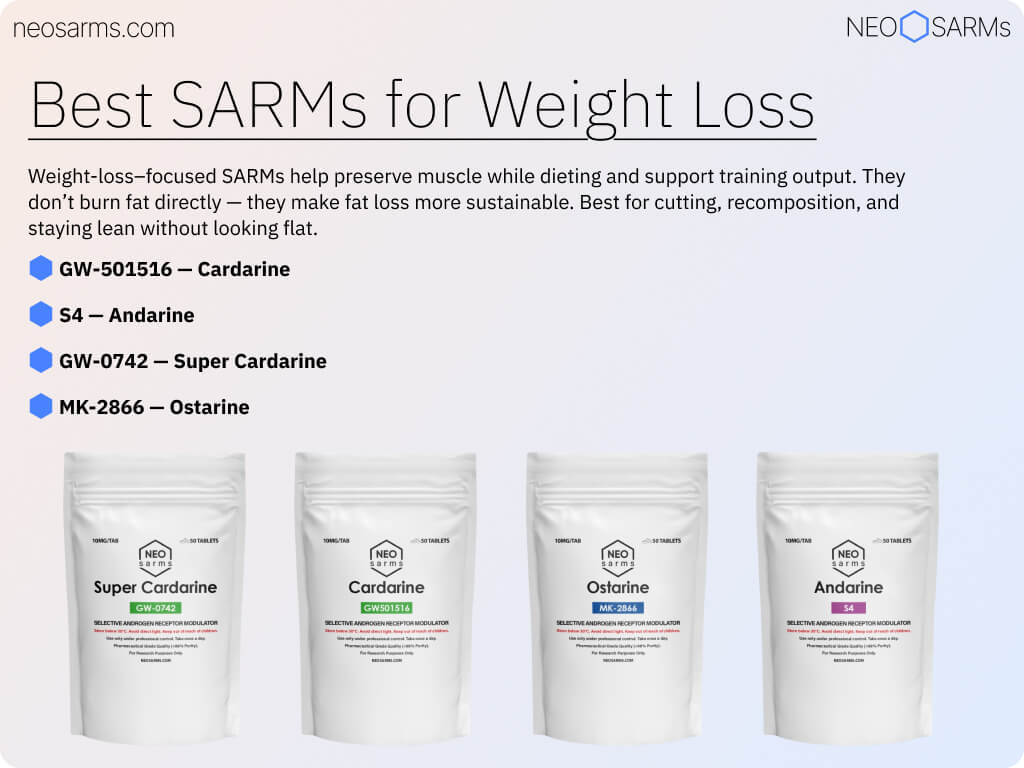
Weight loss SARMs aren’t “burning fat faster” but help you lose fat without losing muscle — which is where most diets fail.
When calories drop, your body doesn’t just burn fat. It also breaks down muscle tissue. The SARMs below are commonly chosen because they help preserve lean mass, improve training quality, and bias the body toward a leaner outcome.
Andarine (S-4)
Andarine is often associated with cutting phases because it emphasizes strength, hardness, and muscle retention rather than size. It helps muscles stay “switched on” during calorie deficits, which can prevent that flat, depleted look people get while dieting.
-

Andarine S4
From $55.00

Cardarine (GW-501516)
Cardarine isn’t a SARM, but it’s almost always discussed alongside them for fat loss. It doesn’t activate androgen receptors at all. Instead, it improves endurance and fat oxidation, allowing longer and more productive training sessions without adding body weight.
-
Cardarine GW-501516
From $82.50

Ostarine (MK-2866)
Ostarine is frequently chosen for recomposition because it sits right in the middle:
mild anabolic signaling, good muscle preservation, and manageable intensity. It’s often used by people who want to look leaner without feeling like they’re running something aggressive.
-
Ostarine MK-2866
From $72.50

Super Cardarine (GW-0742)
GW-0742 works similarly to Cardarine, but with a stronger performance and endurance bias. It’s commonly selected by more active users who want fat loss support without sacrificing output in the gym or in conditioning-heavy training.
-
Super Cardarine GW-0742
From $82.50

Why do these work for cutting? They don’t force growth. They protect what you already have while making fat loss easier to sustain.
Want to lose fat while preserving muscle and performance?
Explore cutting SARMsSARMs for Bulking (aka Muscle Growth)
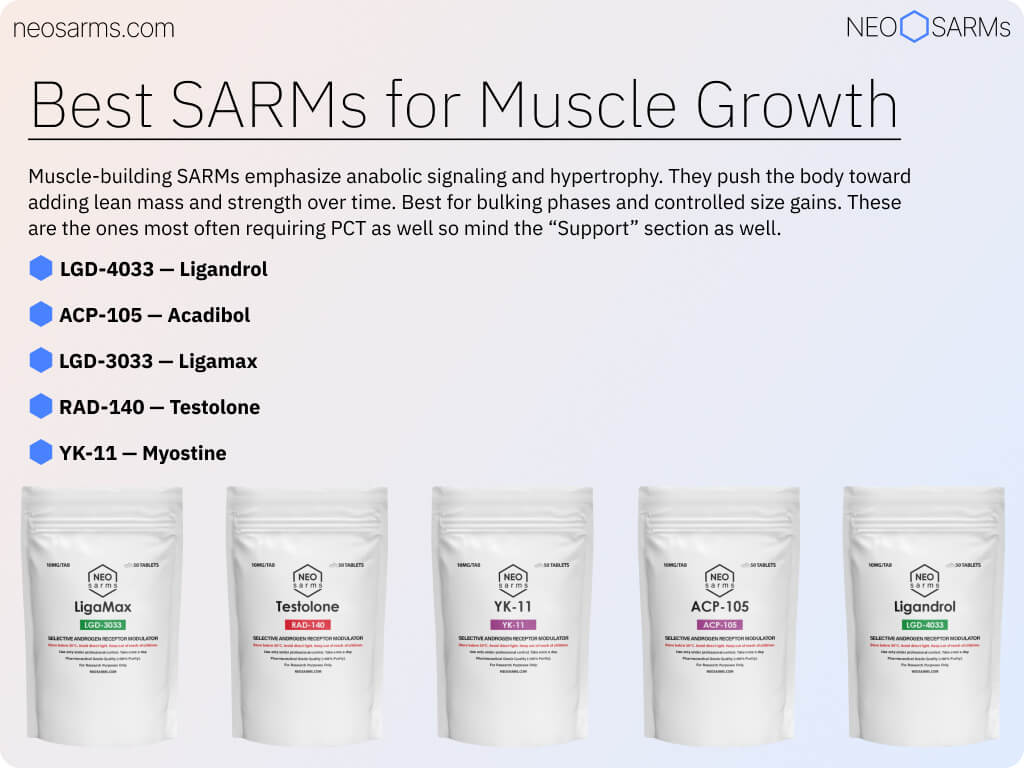
Bulking SARMs are chosen for one reason: they push muscle growth signals harder.
These compounds activate androgen receptors more strongly, stay active longer, or bias toward strength and hypertrophy. As a result, they demand more experience, more recovery planning, and more respect.
LGD-4033 (Ligandrol)
LGD-4033 is one of the most popular bulking SARMs because it reliably promotes lean mass and strength gains. It’s often considered the entry point into “serious” bulking SARMs.
-
Ligandrol LGD-4033
From $77.50

LGD-3033 (Ligamax)
LGD-3033 is generally regarded as a more aggressive, performance-oriented compound than LGD-4033. It’s less beginner-friendly and usually chosen by users with prior experience who want a sharper anabolic effect.
-
Ligamax LGD-3033
From $72.50

ACP-105
ACP-105 occupies an interesting space. It provides anabolic support without the same reputation for heaviness as larger bulking compounds. Some users prefer it for lean bulking, where quality mass matters more than sheer size.
-
Acadibol ACP-105
From $92.50

RAD-140 (Testolone)
RAD-140 is strength-dominant and often described as “dry” or “hard” in its effects. It’s commonly selected by users who want power and size together, not just scale weight.
-
Testolone RAD-140
From $77.50

YK-11
YK-11 is typically classified as an advanced compound. It’s often associated with steroid-like hypertrophy, higher suppression risk, and greater complexity. This is not a casual bulking option.
-
Myostine YK-11
From $77.50

Why do these SARMs work best for bulking? They don’t just preserve muscle — they push the body to build more of it.
Looking to add lean muscle mass and strength?
Explore bulking SARMsSARMs for Endurance & Recovery
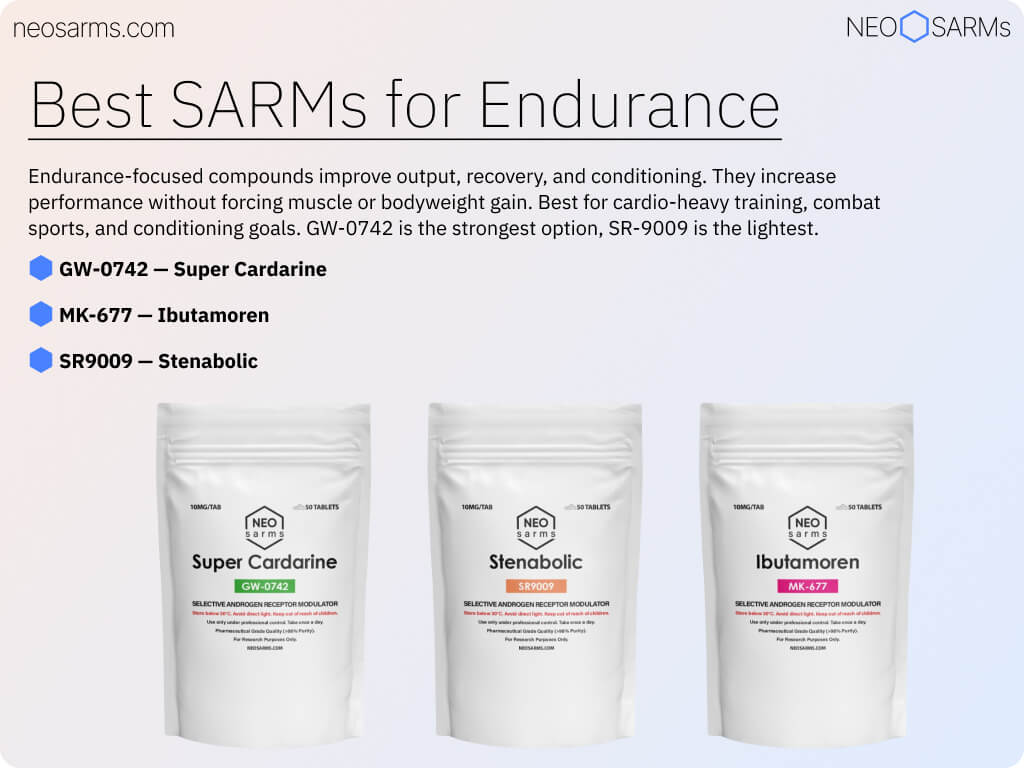
Not everyone wants to be bigger.
Athletes in combat sports, endurance training, or conditioning-heavy disciplines often want:
- Better recovery;
- More output;
- Improved endurance;
- Without gaining body weight.
These compounds are commonly chosen for that reason.
MK-677 (Ibutamoren)
MK-677 isn’t a SARM, but it’s frequently grouped with them because it supports recovery, sleep quality, and appetite through growth hormone signaling. It’s often used when long-term recovery matters more than short-term performance spikes.
-
Ibutamoren MK-677
From $70.00

SR-9009 (Stenabolic)
SR-9009 is non-androgenic and does not build muscle. Instead, it’s used for energy metabolism and endurance, often appealing to athletes who want better conditioning without altering their physique.
-
Stenabolic SR-9009
From $82.50

GW-0742
GW-0742 appears again here because of its strong endurance and fat-oxidation profile. It supports output without driving hypertrophy, making it attractive for weight-class sports or high-volume training.
-
Super Cardarine GW-0742
From $82.50
Why do these 3 options fit endurance goals best? They improve how the body performs and recovers, not how big it gets.
Training for endurance, conditioning, or recovery without added size?
Explore endurance compoundsStep 3 — How to Choose Between a “Stronger” and a “Weaker” SARM?
Once you understand goals and narrow down the list of options, the next question is almost always this:
“If both SARMs do the same thing… why would I choose the weaker one?”
Let’s use a real example.
Bulking SARMs Example — LGD-4033 vs LGD-3033?
Let’s say you’ve looked at graph one — the strength scale. You’re a fairly experienced athlete, so you can choose anything from the middle of it.
You’ve looked at graph 2 — the triangle SARMs by Goal one. Your goal is just bulking, off-season. It means you can choose ACP-105, LGD-4033 or LGD-3033. You’ve tried ACP-105 before and didn’t like it.
It leaves you with two similar options: Ligandrol and Ligamax, aka LGD-4033 or LGD-3033. So which one should you buy if both fit your criteria?
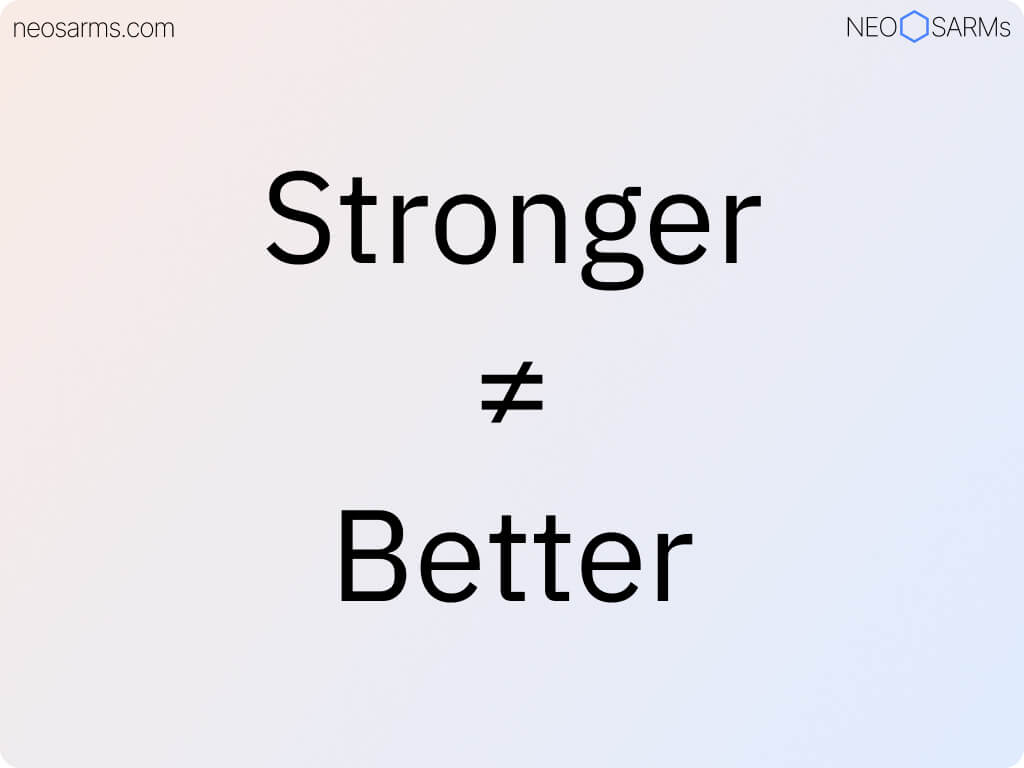
A common mistake is assuming “Stronger = better”. That’s almost never true in training, nutrition, or pharmacology.
Instead, think like this:
- Weaker option = slower, steadier, easier to manage;
- Stronger option = faster, heavier, requires more experience.
Both can move you toward the same goal — just on different timelines, with different costs.
When does LGD-4033 make more sense?
LGD-4033 is often chosen when:
- You want lean, controlled muscle gain;
- You value predictability;
- You want to see how your body responds before escalating;
- You’re bulking up, but not trying to push extremes.
It’s often described as smoother, more forgiving, easier to recover from.
For many users, this is the right first bulking choice, not because it’s weak — but because it’s appropriate.
When does LGD-3033 make more sense?
LGD-3033 is typically considered when:
- You already know how bulking SARMs feel;
- The goal is more aggressive growth;
- You understand suppression and recovery planning;
- The priority is results over simplicity.
It pushes the same direction as LGD-4033 — just harder.
That doesn’t mean “better for everyone”, it means more demanding.
This logic applies everywhere — not just bulking. You’ll see this pattern across SARMs:
- Ostarine vs stronger cutting compounds;
- GW-501516 vs GW-0742;
- Single compounds vs stacks.
If you — for example — are currently not looking for something more intense, you want a chill ride, some extra help — but not breaking any PRs, your answer is LGD-4033.
And that successfully narrows down the whole SARMs line-up we have in stock to just one option. Congrats — you’ve learned that choosing the best SARM for your goals is actually fairly easy.
The next step is to get support for it (Nolva, just in case), examine the protocol (attached to each SARM we have on sale), and just go with it — slowly, gradually, and effectively.
-
Ligamax LGD-3033
From $72.50 -
Ligandrol LGD-4033
From $77.50
Conclusion
We hope this guide helped you understand what SARMs are, how they differ from other performance compounds, and how to choose the right ones based on your goals and experience level.
SARMs can seem complicated at first, but once you strip away the noise, the logic is simple: different compounds emphasize different outcomes, and intensity matters just as much as the goal itself.
That said, it’s important to be clear about one thing:
SARMs are research chemicals. They are not approved dietary supplements and are intended for research purposes only. While we do our best to provide accurate, practical information, we are a SARM manufacturer, not an independent third-party authority.
This guide is meant to educate and orient, not to replace your own research or professional judgment. We strongly encourage you to continue learning, reading, and understanding the broader context before making any decisions.
Good sources of information are:
- r/SARMs on Reddit — the collection of personal experiences and first-hand accounts;
- Sarms Central — with calculators, wiki-style articles, and practical tips;
- And of course, PubMed has plenty of studies on SARMs— if you want direct sources.
If you’ve made it this far, you’re already more informed than most. We hope you’re feeling clearer, more confident, and better equipped to understand this unique class of compounds!
Neosarms is a trusted SARM manufacturer since 2010
We’ve operated as a wholesale laboratory for over a decade. Today, we make our products directly accessible to customers through our website — with the same standards, testing, and consistency.
Shop All SARMsReferences
- Systematic Review of Safety of Selective Androgen Receptor Modulators in Healthy Adults: Implications for Recreational Users https://pmc.ncbi.nlm.nih.gov/articles/PMC10204391/
- Selective Androgen Receptor Modulators (SARMs) Effects on Physical Performance: A Systematic Review of Randomized Control Trials https://onlinelibrary.wiley.com/doi/10.1111/cen.15135
- Selective Androgen Receptor Modulators (SARMs) Are Dangerous — Here’s Why https://health.clevelandclinic.org/sarms-harmful-side-effects-and-risks
- Selective androgen receptor modulators: a critical appraisal https://www.frontiersin.org/journals/endocrinology/articles/10.3389/fendo.2025.1634799/full
- Self-Reported Side Effects Associated With Selective Androgen Receptor Modulators: Social Media Data Analysis https://www.jmir.org/2025/1/e65031/
- Recreational Use of Selective Androgen Receptor Modulators https://www.uspharmacist.com/article/recreational-use-of-selective-androgen-receptor-modulators
- Study to evaluate the safety & efficacy of 13 weeks of SARM GSK2881078 https://www.hra.nhs.uk/planning-and-improving-research/application-summaries/research-summaries/study-to-evaluate-the-safety-efficacy-of-13-weeks-of-sarm-gsk2881078/
- Selective Androgen Receptor Modulators https://www.ncbi.nlm.nih.gov/books/NBK619971/
- Selective androgen receptor modulation for muscle weakness in chronic obstructive pulmonary disease: a randomised control trial https://thorax.bmj.com/content/78/3/258
- Selective androgen receptor modulators: the future of androgen therapy? https://tau.amegroups.org/article/view/32604/html